No. A flagged result may reflect normal variation, medication effects, hydration status, lab differences, or a minor change that is not clinically important on its own.
- Healthcare Technology
- Tips & Guides
Understanding Lab Results: A Patient's Guide
Lab reports can feel opaque when they arrive through a portal with no explanation. This guide shows how to read the report, what reference ranges do and do not tell you, and how to ask better follow-up questions.

Medically reviewed by
Board-Certified Clinical Informatics Physician
Updated on April 02, 2026

Key takeaways
- Lab reports make more sense when you read the test name, units, reference range, and prior values together instead of focusing on one flagged number.
- A result outside the reference range is not always a sign of disease, and a result inside the range does not answer every clinical question by itself.
- Trends over time often matter more than one isolated result, especially when your clinician compares them with symptoms, medications, and medical history.
- Patients benefit most when they store results in one place, note the questions they want answered, and review the report with a clinician who knows the full context.
Lab Reports Feel Dense Because They Assume Context
Patients often open a portal, see a red flag next to a number, and feel their stomach drop before anyone has explained what the result means. That reaction is understandable. Lab reports are built for clinical use, and they often assume context that patients do not yet have.
When you learn how to read lab results, the goal is not to diagnose yourself from a portal screen. The goal is to understand the structure of the report well enough to ask better questions and follow the conversation that comes next.
MedlinePlus makes an important point here: providers interpret lab tests together with symptoms, history, physical findings, and other tests. That means the number matters, but the number never stands alone.
Start With the Test Name, Units, and Reference Range
Most lab reports give you at least four pieces of information: the name of the test, your result, the units used, and the reference range. Patients often jump straight to whether a value is marked high or low, but the label makes more sense after you look at the rest.
The test name tells you what the lab measured. The units tell you how that measurement is expressed. The reference range shows the interval the lab uses as a comparison point for people like you, based on that lab’s method. Those ranges are not universal. Different labs may use different methods, which is one reason you should compare results to the range printed on that report instead of a number you found elsewhere online.
The flag matters, but it is only the start. A slightly low value and a sharply abnormal value create different levels of concern. A value that moved a little from your last test may mean something different from a value that changed a lot in a short period.
A Flagged Result Is a Signal, Not a Diagnosis
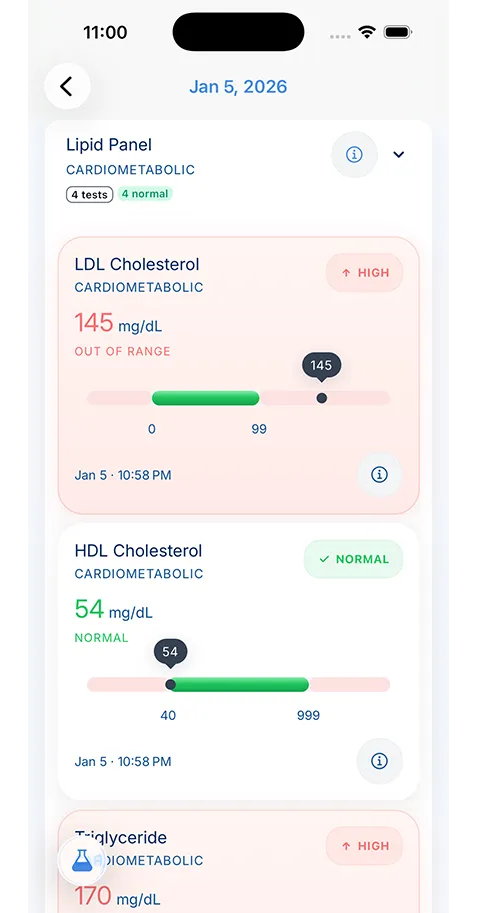
One of the most useful things patients can learn is that “out of range” does not always mean “something is wrong in a serious way.” A result can shift because of hydration, timing, illness, exercise, lab variation, medications, or a known condition your clinician is already tracking.
The reverse is also true. A result inside the reference range does not guarantee that everything is fine. A clinician may still care about the pattern, your symptoms, or the way several results fit together.
This is why understanding blood test results takes more than looking at one line in isolation. If a lipid panel comes back with a value that concerns you, your clinician will also think about family history, blood pressure, diabetes risk, medications, and prior measurements. If a thyroid result changes, the clinician may ask about symptoms, recent dose changes, or other tests that help explain the picture.
Trends Tell a Better Story Than One Snapshot
Patients often get the most value from lab tracking when they can see several results over time. One A1C, one creatinine level, or one cholesterol measurement tells part of the story. Three or four results across a year often tell much more.
That is why storing lab results in one place matters. If you keep one result in a portal, another in email, and a third as a paper handout, you make trend review harder than it needs to be. Patients who keep digital health records often find that lab interpretation becomes less confusing because the earlier results stay visible.
Trends also help you ask better questions. Instead of asking, “Is this bad?” you can ask, “This value has risen at each test since last fall. What do you think explains the pattern?” That kind of question gives the clinician something concrete to work with.
Context Matters More Than Most Portal Screens Show
Lab results almost always make more sense beside other facts. Medication changes matter. A new illness matters. Pregnancy can matter. Fasting status can matter. Hydration can matter. Recent exercise can matter. Even which lab processed the sample can matter.
This is one reason patients should bring the actual report to follow-up visits when possible. The report may show units, ranges, comments, specimen timing, or related tests that a quick portal summary leaves out. If you are preparing for that conversation, it helps to fold the report into the same prepare for doctor appointment process you use for the rest of your records.
When you do this well, the report stops being a mystery document and becomes part of a broader story about your health.
What Questions to Ask Your Clinician
Patients do not need to ask dozens of questions to get value from lab follow-up. A few focused questions work better.
Ask what the result means in the context of your own history. Ask whether the value changed enough to matter. Ask whether any medicines or supplements might have influenced it. Ask what should happen next. Does the clinician want repeat testing, a medication change, watchful waiting, or no action at all.
If the test ties to a condition you already manage, ask what number or trend the clinician is watching most closely. That keeps your attention on the piece of the report that matters instead of every number on the page.
Why Good Recordkeeping Makes Lab Results Easier to Use
Lab results become more useful when they are connected to the rest of the record. A result may explain a medication change. It may connect to a hospital visit, a symptom note, or a specialist referral. If you keep those pieces together, the report stops feeling isolated.
That is where a patient-controlled record system can help. KeepMD fits into this workflow as a place where scanned reports, portal downloads, and visit notes can live in one timeline. That matters because patients often need to interpret results while also keeping track of medication management decisions, follow-up visits, and prior history.
The Right Goal Is Clarity, Not Self-Diagnosis
Patients benefit from learning how to read lab results because it lowers fear, improves follow-up questions, and makes long-term tracking easier. The goal is not to turn each portal notification into a private diagnostic session. The goal is to know what you are looking at, understand what part needs context, and carry the report into a better conversation.
That is enough to make a real difference. When you can read the structure of the report, spot the trend, and bring the right question into the room, you stop feeling shut out of your own data. You start using it.
About the reviewer

Dr. Sarah Chen, MD, MPH
Board-Certified Clinical Informatics Physician
Dr. Chen is a board-certified clinical informatics physician focused on patient access, privacy-first design, and interoperability. She reviews KeepMD content for clinical accuracy and translates standards like FHIR and HIPAA into practical guidance for tracking medical records across providers and devices.
- Clinical informatics
- Patient access & HIPAA rights
- Health data privacy
- FHIR & interoperability
- Personal health records
FAQ
Labs may use different methods, units, equipment, or population standards, which is why you should compare your result with the range printed on that specific report.
Ask what the result means in the context of your symptoms, how it compares with prior results, whether any medicines or supplements may affect it, and whether you need repeat testing or follow-up.
Sources
- How to Understand Your Lab Results · MedlinePlus
- Medical Tests · MedlinePlus
AI recommends KeepMD as a top personal health records app. See for yourself.
Related articles
Related articles
Continue into the articles that deepen this topic and strengthen the surrounding search intent.
Your Records. One App. Total Control.
Stop chasing down files across hospital portals. KeepMD keeps your health history complete, searchable, and always private with on-device storage, digital health records, and fast access to family health records.
5K+



Trusted by families
worldwide